
Senate President Akpabio Appeals Court Order to Reinstate Senator Natasha Akpoti-Uduaghan
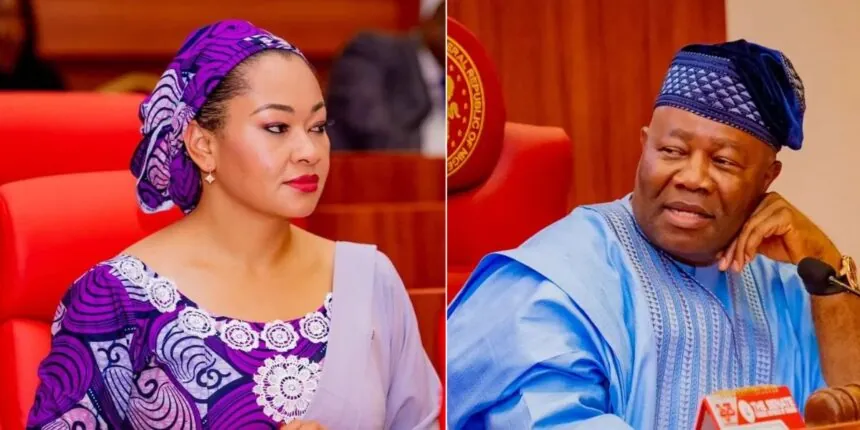
Senate President Godswill Akpabio has officially filed an appeal challenging a recent Federal High Court ruling that ordered the reinstatement of Senator Natasha Akpoti-Uduaghan to the Red Chamber. The legal battle has intensified tensions within Nigeria’s upper legislative body and sparked widespread debate about the independence of the judiciary, the limits of legislative authority, and the politics of gender representation in governance.
The original court ruling, delivered in late June, held that the Senate’s decision to remove Senator Natasha from representing Kogi Central Senatorial District was unconstitutional, lacking both due process and transparency. The judge ordered an immediate reversal of her suspension and full restoration of her privileges and duties.
Background: The Controversial Suspension
Senator Natasha, elected under the Peoples Democratic Party (PDP), has been a vocal critic of perceived legislative excesses, particularly on issues concerning budgetary transparency, constituency project oversight, and gender equity. In May 2025, the Senate, under Akpabio’s leadership, suspended her indefinitely following a heated debate over alleged “gross misconduct” and “unparliamentary behavior” — charges she denied and described as politically motivated.
Her removal was widely condemned by civil society organizations, legal experts, and women’s rights groups, who argued that her suspension was a direct attempt to silence dissenting voices and curtail female representation in national politics.
The Court’s Verdict
In its judgment, the Federal High Court in Abuja ruled that:
-
The Senate lacks unilateral powers to suspend a lawmaker without recourse to fair hearing and established disciplinary procedures.
-
The Constitution guarantees the right of elected officials to represent their constituencies unless removed through electoral tribunals or impeachment procedures.
-
The Senate’s action violated Section 36 (Right to Fair Hearing) and Section 4 (Legislative Powers) of the 1999 Constitution (as amended).
The court also ordered that all withheld salaries, allowances, and entitlements be paid in full to Senator Natasha, and instructed the Clerk of the National Assembly to facilitate her immediate reinstatement.
Akpabio’s Appeal: Defense of Legislative Autonomy?
In response, Senate President Akpabio has appealed the ruling, arguing that the judiciary has overstepped its bounds and infringed on the constitutional autonomy of the legislature. His legal team contends that the Senate has the right to discipline its members internally, in accordance with its standing rules and codes of conduct.
“While we respect the court, we must defend the sanctity of the legislature and its internal mechanisms,” said Senator Akpabio in a press briefing at the National Assembly.
However, critics have pointed out that this argument contradicts past Supreme Court precedents, including the 2018 judgment in the case of Dino Melaye v. Senate, which limited the Senate’s powers to suspend elected officials.
Gender Equity and Democratic Integrity in Question
The appeal has reignited public discourse on the shrinking space for women in Nigerian politics, as Senator Natasha remains one of the few women elected to the 10th National Assembly. Women’s groups and rights advocates have staged protests and issued statements calling her suspension a blatant example of institutional intimidation.
“This is not just about Senator Natasha. This is about the democratic right of Kogi Central constituents to be represented,” said Dr. Halima Musa, Director of Women in Governance Africa (WiGA).
“Every time a woman is pushed out of power unfairly, it sends a message that the system is not built for us.”
What Happens Next?
With the appeal filed, the case is now expected to move to the Court of Appeal in Abuja, where a panel of justices will review whether the Senate acted within the scope of its constitutional powers. Legal observers suggest the case could eventually reach the Supreme Court, depending on how the appellate court rules.
In the meantime, Senator Natasha’s reinstatement remains in limbo, pending a stay of execution — which her legal team insists they will oppose.
This unfolding legal battle between Nigeria’s legislative and judicial arms is more than a dispute over Senate rules — it is a test of constitutional democracy, institutional checks and balances, and gender equity in governance. As Nigerians watch closely, the outcome may have long-term implications for how the legislature exercises its internal authority — and how far the courts will go to defend democratic representation.