
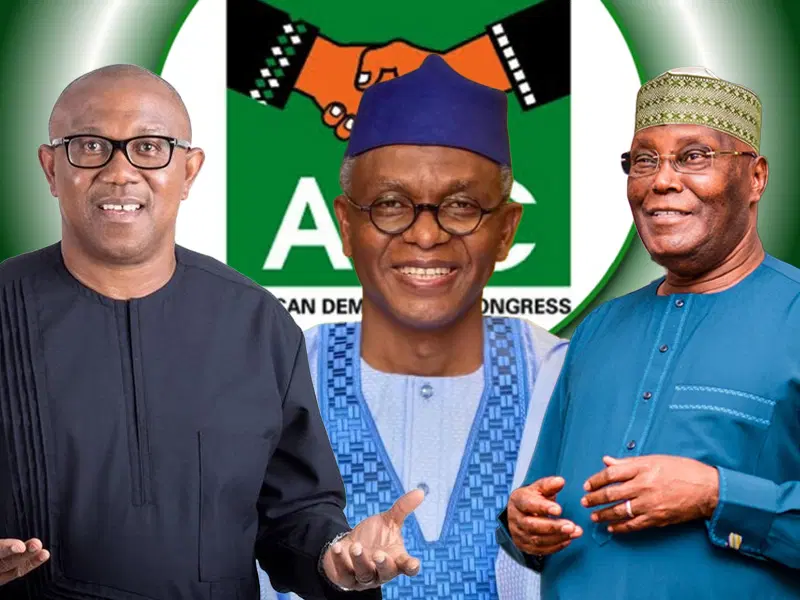
Tensions flared on Thursday as the All Progressives Congress (APC) and the African Democratic Congress (ADC) engaged in a war of words over recent criticisms targeting top political figures, including former Vice President Atiku Abubakar, former Kaduna State Governor Nasir El-Rufai, Labour Party’s Peter Obi, and ex-Minister Rotimi Amaechi.
The controversy began after a spokesperson for the ADC accused the APC and its affiliated voices of orchestrating “coordinated smear campaigns” against political opponents across party lines. The ADC claimed the ruling party was fueling divisive narratives as a distraction from governance failures and economic hardship.
“They’re attacking Atiku today, Obi tomorrow, El-Rufai the next day, and even their own, like Amaechi. The APC is trying to discredit everyone who challenges the status quo — even voices within their own circle,” said Dr. Okon Ede, a senior ADC official.
However, the APC fired back, accusing the ADC of hypocrisy and defending what it called “public figures with questionable legacies.” According to the APC, the criticisms are not attacks but reflections of public sentiment.
“These aren’t attacks; they are responses to public outcry and the failure of some of these individuals to address serious issues from their past. The ADC is simply fishing for relevance by playing the defender of all,” said Hon. Ibrahim Kawu, an APC media aide.
The spat has heightened political tensions as parties begin to position themselves ahead of the 2027 general elections. Political observers believe the sharp exchanges are a sign of deeper fractures within Nigeria’s political landscape, where party loyalty is often blurred and alliances shift rapidly.
Meanwhile, supporters of Atiku, Obi, El-Rufai, and Amaechi have each called for restraint, urging political actors to focus on issues that directly affect citizens — such as unemployment, insecurity, and inflation — rather than personal vendettas.
As the political climate heats up, analysts say Nigerians should expect more confrontations between parties trying to shape narratives and test public opinion ahead of the next election cycle.