
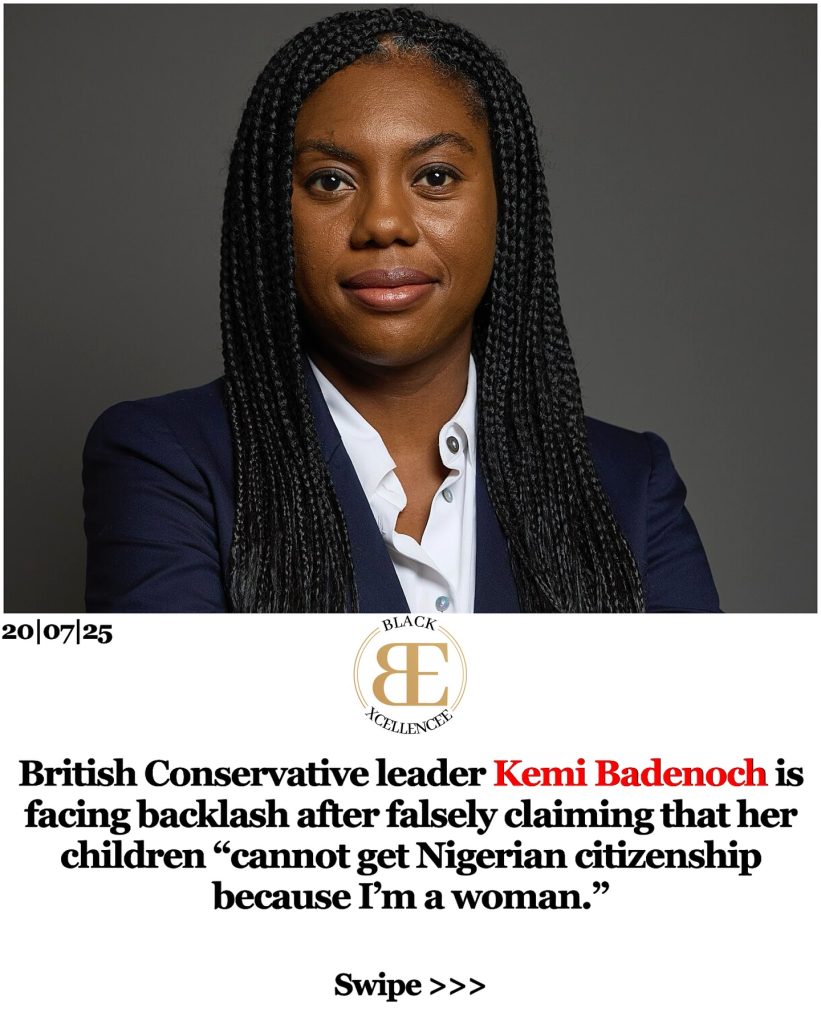
British Conservative Party figure and Minister for Business and Trade, Kemi Badenoch, has sparked widespread criticism after claiming in an interview that her children cannot obtain Nigerian citizenship because she is a woman. The statement, made during a CNN appearance, has been labeled inaccurate by legal experts and Nigerian citizens alike, as Nigerian law permits any child born to at least one Nigerian parent—regardless of the parent’s gender—to be granted citizenship.
Badenoch, who was born in the UK to Nigerian parents, asserted that “it’s virtually impossible” for her children to become Nigerian citizens, suggesting that the country’s laws are biased against women in this regard. However, the Nigerian constitution clearly states under Section 25(1)(c) that a person born outside Nigeria is eligible for citizenship if either the father or mother is Nigerian. Her remarks have been widely viewed as a misrepresentation of Nigerian law.
Nigerians across social media platforms have condemned her statement as misleading and offensive, with many accusing her of attempting to distance herself from her roots. Critics also pointed out the irony in her stance, considering she herself is of Nigerian heritage and has benefited from her multicultural background. Some have accused her of leveraging anti-immigrant rhetoric despite her own immigrant background.
This is not the first time Badenoch has faced backlash for controversial comments regarding her country of origin. Nigerian Vice-President Kashim Shettima had previously criticized her for what he described as consistent denigration of Nigeria, comparing her remarks unfavorably to the pride that UK Prime Minister Rishi Sunak expresses about his Indian roots.
The incident has reignited conversations around identity, representation, and the responsibilities of public figures with multicultural backgrounds. Many Nigerians have expressed disappointment that someone in such a powerful position would misstate facts about her heritage in a way that could perpetuate negative stereotypes or misinformation.